Arlington got a bridge in 1953 and a city government in 1968. For those fifteen years, it was the fastest-growing part of Duval County, growing in unincorporated territory with no city planning department, no zoning overlay, and no design review. Tens of thousands of houses went up in a place that, administratively speaking, wasn't anywhere.
That sequence explains most of what you'll notice driving around out here. It's also why Arlington is the fifth completely different regulatory situation we've written about in this series: it has no historic district, and no design review on your house. What it has instead is a redevelopment agency sitting on roughly $10 million, which produced a binding zoning overlay that is now in the City's code.
Money first, rules later.
New to the city? Start with our guide to living in Jacksonville, then come back.
Arlington Was Never One Place
Before the bridge, this side of the river was a scattering of small separate communities connected by trails and footpaths: Floral Bluff, Eggleston, Clifton, Chaseville, and Gilmore. Arlington has never been an incorporated town. It was unincorporated Duval County right up until the 1968 consolidation swept everything in.
A few things were here long before the mid-century boom:
Strawberry Plantation: Roughly 8,000 acres granted around 1795 to François Richard. A great deal of antebellum downtown Jacksonville was built from brick made at Strawberry by enslaved people.
Atlantic Boulevard: Completed in 1910 and initially built using convict labor under the Duval County Commission. It is described as Florida's first modern improved highway.
The Bridge, and the Toll
The John E. Mathews Bridge opened on April 15, 1953. Funded by bonds and tolls, the steel cantilever truss bridge cost roughly $11 million.
Here is the part that shaped the area's layout: it was a toll bridge for thirty-six years. Tolls didn't come off until 1989. Because crossing the river cost money twice a day, commercial corridors developed heavily on this side of the water. Town & Country Shopping Center opened in 1955, and Regency Square followed in 1967. By 1955, the bridge was carrying 19,000 cars a day, fueling the fastest-growing part of Jacksonville outside city government.
What Got Built
Arlington is where Jacksonville's mid-century modern housing is. If your taste runs to clean lines, low-slope roofs, terrazzo floors, and walls of glass, this is the part of Jacksonville that has them.
The scale of postwar development here was driven by a few notable figures:
H. Terry Parker: Started buying Arlington land around 1943 and held 1,800 acres by 1959.
Pearce-Uible Company: Jacksonville's largest postwar builder developed Arlington Manor and Sandalwood, which started in 1960.
Robert C. Broward: Designed the "Butterfly House" in Alderman Park for a 1957 Parade of Homes exhibition.
The Inspection Reality: It's About Insurability
Arlington's due diligence profile is different in kind from other Jacksonville neighborhoods. Almost every era-specific item here is an insurance eligibility question rather than a simple repair question.
Florida insurers generally require a four-point inspection—roof, electrical, plumbing, HVAC—on older homes before they will write a policy. The four-point inspection determines whether a carrier will write the house at all, or if they will require work to be done first.
Aluminum branch wiring: When copper prices spiked, builders substituted solid single-strand aluminum in branch circuits roughly between 1965 and 1973—overlapping Arlington's peak build-out almost exactly. Consumer Product Safety Commission-recognized repairs exist, including COPALUM crimps and AlumiConn connectors, meaning a full rewire is not the only option.
Original electrical panels: Certain brands common to this era are specifically flagged on four-point inspections and require a licensed electrician's evaluation.
Plumbing: Cast iron drain lines and galvanized supply lines were standard. Get a sewer scope. Polybutylene supply lines show up in later 1980s infill and are treated differently by carriers.
Jalousie windows: These glass louvers seal poorly, and original ones affect how a house is classified for opening protection on a wind mitigation inspection.
Flat and low-slope roofs: Insurers treat these differently from shingle roofs, and age heavily drives eligibility.
Terrazzo floors: An asset, often hiding under carpet, that requires a specialized diamond-grinding trade to restore.
The practical step: get an insurance quote on the specific address early in your inspection period, from a licensed agent, before you spend money on anything else.
The Governance: A CRA, an Overlay, and Where It Stops
Arlington has no historic district at any level. Jacksonville's three local historic districts are Riverside and Avondale, St. Johns Quarter, and Springfield—Arlington isn't among them.
What it has instead is the Renew Arlington Community Redevelopment Agency (CRA). Established in 2015, it covers three commercial corridors: University Boulevard, Merrill Road, and Arlington Road. Funded by tax increment financing, the CRA reinvests captured ad valorem revenue increases back into the district.
In 2019, the City adopted the Renew Arlington Zoning Overlay, creating binding land-use regulation for the corridors, regulating fencing, landscaping, signage, and parking.
The part that matters if you're buying a house: The overlay expressly does not apply to RLD or RMD-A zoning districts. An ordinary single-family house in a low-density residential district inside the CRA boundary is exempt from the overlay entirely—no overlay design review and no overlay certificate. Other city permitting still applies.
Arlington has exactly one local landmark: the former Arlington Federal Savings & Loan at 930 University Boulevard North. Built in 1961 with a precast concrete façade of triangles and diamonds, it was designated in December 2023. Alteration of its street-facing portions requires a Certificate of Appropriateness.
What Arlington Is Built On
After the Civil War, formerly enslaved families established settlement communities across this side of the river, several on former Strawberry Plantation land.
Mount Zion and Chaseville: Mount Zion traces to 1862, with the church organized in 1866. Chaseville formed around a shipyard employing African American Civil War veterans.
Erasure by Mining: From 1944 to 1961, the Humphreys Gold Corporation mined ancient beach sands at Mount Zion for titanium minerals. The mining operation, followed by the bridge and mall construction, physically erased much of the original settlement landscape.
What Survives: The Mount Zion United Methodist Church building and Lone Star Cemetery at 1238 Ballard Ridge Road remain, with burials dating back to 1862.
Two other critical pieces of history sit in Arlington:
Anna Madgigine Jai Kingsley: Born in present-day Senegal in 1793, enslaved, and later a planter and property owner in her own right as a free Black woman, she settled in Arlington and died here in 1870. Her burial place is unmarked.
Norman Studios: Located at 6337 Arlington Road, Richard Edward Norman produced silent films with all-Black casts from 1919 to 1928. The National Park Service notes it is one of the few preserved race film studios in the country. Check with the studio for public access before planning a visit.
Fort Caroline Is Here, Not on the Northside
Fort Caroline National Memorial and the Theodore Roosevelt Area are in Arlington, not on the Northside. The Timucuan Ecological and Historic Preserve spans both sides of the river, which confuses many. Kingsley Plantation and the Ribault Club are on the Northside; Fort Caroline and the Ribault Monument (at St. Johns Bluff) are here.
The Fort Caroline site features an interpretive reconstruction, as the original 1564–65 fort's exact location has never been definitively established.
Regency Square and the Commute
Regency Square Mall opened in 1967 in unincorporated Duval County. It officially closed in June 2025, and demolition of the structure began in September 2026. The project is in active litigation, and construction timelines can shift.
For commuters, there is one primary crossing to downtown: the Mathews Bridge. It is FDOT-maintained and has undergone phased rehabilitation work. Check nflroads.com for current activity before committing to a commute, and drive the route on a weekday at your hour.
Places Worth Knowing
Jacksonville University: Opened a campus here in 1950, covering about 235 acres on the riverfront.
Jacksonville Arboretum & Botanical Gardens: Opened in 2008 on Millcoe Road. The property sits on ground previously excavated for titanium minerals.
Tree Hill Nature Center: A nonprofit preserve on Lone Star Road operating since 1971.
Jacksonville Executive at Craig Airport: A general aviation field on St. Johns Bluff Road. General aviation noise is a documented consideration if you are looking near it.
Neighboring Options
San Marco — across the river, no historic designation, but an entirely different housing era.
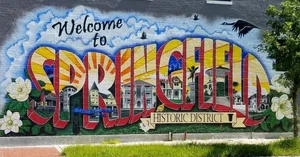
Springfield — National Register, local designation, and its own zoning code.
Mandarin — no historic district, with infrastructure burdens generally moved onto the owner.
Frequently Asked Questions
Is Arlington a historic district? No. Arlington is not locally designated and is not a National Register district. It has one individual local landmark, the former Arlington Federal Savings & Loan building, plus a handful of individual National Register listings.
What is the Renew Arlington CRA, and does it affect my house? It's a Community Redevelopment Agency covering specific commercial corridors, which produced a zoning overlay in 2019. The overlay expressly does not apply to RLD or RMD-A zoning districts, so an ordinary single-family house in a low-density residential district is exempt.
What should I have inspected in an Arlington house? Most era-specific items are four-point inspection items that affect whether a carrier will write the policy: aluminum branch wiring, original electrical panels, cast iron drains, galvanized supply lines, polybutylene, roof age, and original jalousie windows. Get an insurance quote early.
Is Fort Caroline in Arlington or on the Northside? Arlington. The Timucuan Preserve spans both sides of the river, which is where the confusion originates.
Is Regency Square Mall still open? No. It closed in June 2025 and demolition began in September 2026.
Come Look at It With Us
Arlington rewards buyers who know exactly what they are looking at. A mid-century house with good bones and a bad four-point inspection is a very different purchase from one with good bones and a clean one. We'll tell you which is which, and what to ask the City, your inspector, and your insurance agent before you commit.
#ForeverFamilyForeverHome
Contact The Courtney Team
Still mapping the city? Read our full guide to living in Jacksonville.
The Courtney Team | Coldwell Banker Vanguard Realty | Licensed Real Estate Professionals in the State of Florida. Information in this guide is general and educational in nature and is not a representation about any specific property. Descriptions of historic designation, the Renew Arlington CRA and zoning overlay, tax increment financing, inspection and insurance underwriting practices, flood history and flood zones, and development projects are general explanations that change over time and vary by address — all of them must be independently verified for the specific property and the current year. Nothing here is legal, zoning, engineering, environmental, tax, or insurance advice; please consult a licensed attorney, inspector, electrician, CPA, or insurance agent, the City of Jacksonville Planning and Development Department, the City's Historic Preservation Section, and FEMA or City of Jacksonville Development Services as appropriate. Equal Housing Opportunity.