So, you're thinking about Jacksonville.
Maybe a job brought it up. Maybe you visited someone here and the weather in February did something to you. Maybe you've lived here fifteen years and you're finally curious about that part of town you've never had a reason to drive through.
Either way — welcome. Pull up a chair. This is going to take a minute, because Jacksonville is genuinely hard to explain quickly, and most of the guides out there don't really try. They give you a population number, a photo of the skyline at sunset, and a list of five neighborhoods. That's not a guide. That's a brochure.
We're a family team that has been helping people find homes across this metro for years, and we've watched a lot of newcomers make the same handful of expensive assumptions. We've also watched plenty of longtime locals discover they had no idea what was happening twenty minutes from their house. So this guide is written for both of you.
Here's the single most important thing to understand before you look at one listing:
Jacksonville is enormous.
Not "big city" enormous. Geographically enormous. In 1968, the City of Jacksonville and Duval County merged into one government, and overnight the city's boundaries became the county's boundaries. Today Jacksonville covers roughly 875 square miles including water, which makes it the largest city by total area in the contiguous United States.
Sit with that for a second, because it has real consequences. Two houses can both say "Jacksonville, FL" on the envelope, sit in the same county, pay the same county government — and be 45 minutes apart, with completely different architecture, completely different commutes, and completely different price points. You could put the entire city of Miami inside Jacksonville several times over and have room left.
So when someone says "I want to buy in Jacksonville," what they've actually told us is roughly as specific as "I want to buy in Rhode Island."
That's not a criticism. That's just the assignment. Let's narrow it down together.
How Jacksonville Got This Big (It's a Better Story Than You'd Expect)
Skip this section if you just want neighborhoods. Stay if you want to understand why this city works the way it does — because the 1968 consolidation explains an enormous amount about daily life here, right down to why four beach towns have their own police departments.
By the mid-1960s, Jacksonville was in genuine trouble.
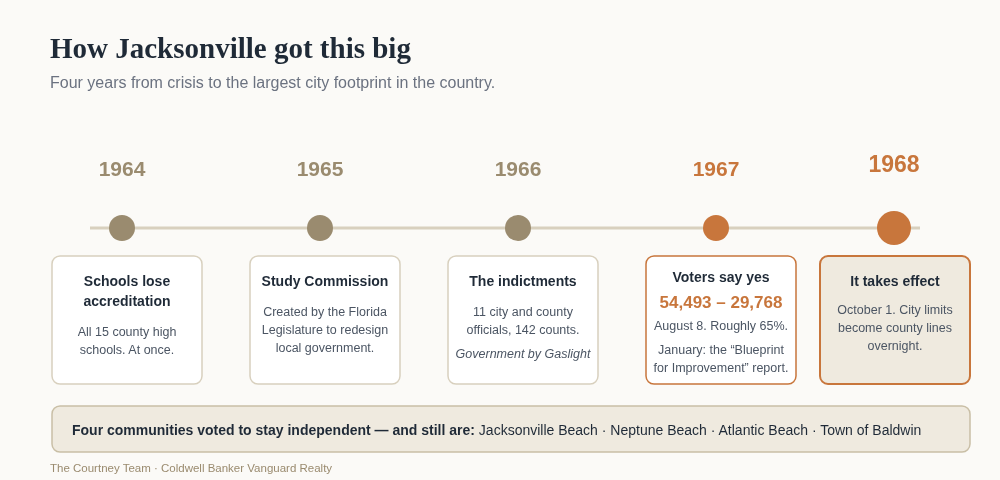
The urban core was hemorrhaging residents and businesses to the suburbs, taking the tax base with them. In late 1964, the Southern Association of Colleges and Schools disaccredited all fifteen Duval County public high schools, citing inadequate financial support. Every high school in the county, at once. Imagine that news landing on your kitchen table.
Then it got worse. In 1966, a grand jury indicted eleven city and county officials on 142 counts of bribery and larceny — four of nine city councilmen, two of five city commissioners, the city auditor, and others besides. The city tax assessor took the Fifth and resigned. A local television documentary called Government by Gaslight laid it out for the public, and public opinion moved hard.
Out of that wreckage came a Local Government Study Commission, created by the Florida Legislature in 1965 and chaired by J.J. Daniel, with businessman Claude Yates having pushed the effort into existence and gone on to lead the campaign for it. Their proposal was titled, with admirable directness, "Blueprint for Improvement."
The coalition that carried it was broader than you might guess for Florida in 1967. Earl M. Johnson, the first Black member of the Jacksonville Bar Association — who had worked alongside Thurgood Marshall and Constance Baker Motley — served as the commission's secretary and mobilized Black support for the referendum. Sallye B. Mathis, a retired teacher and dean, was elected to the City Council that same year alongside Mary L. Singleton: the first women ever to serve on it, and the first Black members in six decades.
On August 8, 1967, Duval County voted to consolidate, 54,493 to 29,768. Roughly 65% in favor. It took effect October 1, 1968, under Mayor Hans Tanzler, and overnight Jacksonville became one of the largest cities in the country by population and by far the largest by area — a distinction it held outright until Alaska's boroughs consolidated in the 1970s.
But four communities said no thanks. Jacksonville Beach, Neptune Beach, Atlantic Beach, and the Town of Baldwin voted to stay independent, and they still are. To make the whole thing work, the new charter split the county into a General Services District covering all of Duval, plus five Urban Services Districts — the old city limits being the first, and each of the four holdout municipalities being the others. Countywide services run through the General Services District; the Urban Services Districts are where the higher level of urban services, and the corresponding higher millage, apply.
That structure is still in force today. It's why your address can say Jacksonville while your police department says Atlantic Beach, and it's why "which district am I in?" is a real question with real money attached.
First, the Honest Stuff Nobody Puts in the Brochure
If you're moving here from out of state, you deserve the real picture before the pretty one. Here's what we tell every relocation client over coffee.
The summers are serious. June through September is hot and humid in a way that photographs don't convey. Afternoon thunderstorms roll through most summer days — often hard, often brief, often followed by steam rising off the pavement. You'll adjust. Locals simply move their outdoor life to mornings and evenings, and everyone becomes deeply opinionated about their air conditioning. Which, incidentally, is why an HVAC system's age is one of the first things we look at on a showing.
The rest of the year is the payoff. October through May is the reason people move here and stay. Mild, bright, and long. You'll see people in shorts in January and jackets in March, sometimes in the same week.
Hurricane season runs June 1 through November 30. This is a fact of life on the Atlantic coast, not a reason to panic, but it is a reason to do homework. Before you buy anything here, you want to know the property's flood zone, its elevation, its roof age, and what windstorm coverage will actually cost. Those four items can meaningfully change your monthly payment, and they vary enormously from one street to the next. We bring them up early on purpose — nobody enjoys finding out at the insurance binder stage.
You will need a car. A few pockets of the city let you walk to dinner and coffee. Getting between parts of the city essentially requires driving. Public transit exists but isn't built for most commutes here.
The bugs are real and then you stop noticing them. Everyone's first summer involves a mosquito opinion. By year two you own a fan for the porch and you've moved on.
Florida has no state personal income tax. That's a genuine factor in a lot of relocation math. It is also not the whole math — property tax rates, insurance, and CDD assessments vary a lot across this metro, and they can quietly erase the difference. Talk to a tax professional about your specific situation rather than trusting a relocation blog. Including this one.
And the thing that surprises everyone: the St. Johns River flows north. It's one of the few major rivers in the United States that does. You'll hear a local mention it within your first month, usually with a little more pride than the fact strictly warrants.
How to Read a Jacksonville Address
Okay. Let's build you a mental map. Once this clicks, every listing you look at will start making sense.
Jacksonville is organized around two things: the river and the bridges over it.
The St. Johns River comes up from the south, runs north through the middle of the city, then makes a hard turn east toward the ocean. That bend is where downtown sits. Everything else orients off it.
Locals carve the city into broad zones. Nobody agrees on the exact borders, and you'll hear people argue about them, but this will get you oriented:
Downtown / Urban Core — both banks at the bend. The Northbank and Southbank.
Riverside / Avondale / Ortega — just west of downtown, hugging the river's west bank. The historic districts.
Southside — south and east of downtown. Where most of the newer retail and office development landed.
Mandarin — the southern tip of Duval County, east side of the river.
Arlington — east of downtown, over the Mathews Bridge.
Northside — everything north of downtown up to the Nassau County line.
Westside — west of the river, stretching out past I-295 toward Baldwin.
The Beaches — the Atlantic strip, cut off from the rest of the city by the Intracoastal Waterway.
Five bridges carry most of the near-downtown river traffic: the Fuller Warren, Acosta, Main Street, Hart, and Mathews. Add the Buckman further south, which is how Clay County gets to work.
Here's the part locals will confirm and newcomers always underestimate: which bridge you depend on will shape your daily life more than almost any feature inside the house. A gorgeous kitchen does not help you at 7:45 a.m. on a backed-up bridge. We are relentless about this with clients, sometimes annoyingly so.
The Neighborhoods
Each of these has its own full guide — this is the overview. Read the ones that sound like your life, skip the ones that don't, and come back later when your plans change. They usually do.
Riverside and Avondale
If you've seen a photo of Jacksonville that made you think "oh, I didn't know it looked like that" — it was probably here.
These are the city's historic districts, sitting west of downtown along the river under an enormous canopy of live oaks. The housing is mostly early 1900s: bungalows, Prairie-style, Tudor Revival, Colonial Revival, and along the water, some very large old riverfront homes. Five Points and the Shoppes of Avondale are the two commercial nodes, and both are the rare Jacksonville places where you can park once and spend an afternoon on foot.
The Cummer Museum of Art & Gardens is here, with formal gardens running down to the river. Memorial Park is here too — a 1920s waterfront park with a striking bronze sculpture at its center, and a genuinely good place to watch the sun go down. On Saturdays, the Riverside Arts Market sets up under the Fuller Warren Bridge, which is a more charming sentence than it sounds like. Check current hours before you go.
The practical reality: lots are small, street parking is a skill, and the houses are old. Old houses are wonderful and old houses have opinions. Knob-and-tube remnants, cast iron drain lines, foundations that have settled into their personality, renovations of wildly varying quality done across a century. None of that is a reason to stay away — it's a reason to hire an inspector who knows historic homes and to read the report carefully. Parts of the area also have flood considerations worth checking address by address.
And the part that catches people: much of Riverside and Avondale sits inside a locally designated historic district, which means exterior work requires a Certificate of Appropriateness from the city before you start. Windows, siding, fencing, driveways, sheds — anything visible from outside. See the section below on historic designation, because the distinction between "local" and "National Register" is where people get genuinely burned.
Look here if you want walkable dinner options, mature trees, and architecture with a story, and you're genuinely okay trading square footage and a two-car garage to get it.
→ Read the full Riverside & Avondale guide
San Marco and St. Nicholas
Straight across the river from downtown on the Southbank, and in a lot of ways Riverside's sibling — similar era, similar tree cover, different feel.
San Marco Square is the heart: a 1920s Mediterranean Revival commercial district built around a fountain with three bronze lions, ringed by restaurants and shops. The neighborhood around it runs from modest historic cottages in St. Nicholas up to substantial homes along the river bluff. The Museum of Science & History sits on the Southbank riverfront nearby, and the Southbank Riverwalk gives you a long stretch of walking path with the downtown skyline directly across the water.
The practical reality: this is one of the shortest drives to downtown of any established neighborhood, which is a large part of its appeal. Like Riverside, it's old housing stock with everything that implies, and some low-lying sections warrant a close look at flood zone and drainage history.
Look here if you want historic character plus a genuinely short commute to the urban core, and you like the idea of walking to dinner without leaving your neighborhood.
→ Read the full San Marco guide
Springfield
Springfield is for people who want a project with a capital P — and there's a real community of them here.
Just north of downtown, it's a National Register historic district with local design review requirements, built out largely in the Victorian era. The housing stock is spectacular in its bones: wraparound porches, turrets, high ceilings, heart pine floors under whatever came later. A meaningful share of the inventory is somewhere in the middle of restoration, and the neighborhood has spent decades in an ongoing revival driven substantially by people who bought a house and got to work.
The practical reality: Springfield is both a National Register district and a locally designated one, which means design review has actual teeth here. Exterior changes need a Certificate of Appropriateness first. Most are approved administratively, but demolition of a contributing structure, new construction, and two-story additions go before the Historic Preservation Commission, which meets monthly. Plan your timeline around that, not around your contractor's availability.
Condition varies dramatically house to house — some are beautifully finished, some are studs and ambition. Budget honestly, get contractor quotes during your inspection period rather than after closing, and price the historically appropriate materials rather than the big-box equivalents, because that gap is where restoration budgets go to die.
Look here if you want a remarkable old house, you're energized rather than exhausted by renovation, and you like being close to downtown.
→ Read the full Springfield guide
Mandarin
Mandarin occupies the southern tip of Duval County along the east bank of the river, and it has a distinct feel — heavily wooded, older, and a little more spread out than what surrounds it.
There's real history here. Harriet Beecher Stowe wintered in Mandarin in the decades after the Civil War and wrote about the area, and the community kept a rural identity long after the rest of the city grew around it. You can still feel that in the tree cover and the way some of the older roads wander.
Housing splits roughly two ways: older, larger, wooded lots toward the river — some with serious acreage and water access — and a wide mix of subdivisions built from the 1970s forward as you move east toward San Jose Boulevard and Hood Road. Julington Creek forms the southern boundary with St. Johns County, which means Mandarin residents often shop, eat, and socialize across a county line without thinking about it.
The practical reality: San Jose Boulevard is the main artery and it carries a lot of traffic. Drive it at rush hour before you commit to an address off it. Older riverfront properties can carry septic systems, wells, dock permitting questions, and flood considerations — all knowable, none of them dealbreakers, all of them things you want to know early.
Look here if you want mature trees and more lot than the urban core offers, with straightforward access south into St. Johns County and north into the Southside job centers.
→ Read the full Mandarin guide
Southside, Baymeadows, and the Tinseltown Area
If Riverside is where Jacksonville keeps its history, Southside is where it put its growth.
This is where most of the newer retail, office, restaurant, and apartment development landed over the last several decades. The St. Johns Town Center — a large open-air shopping district — anchors it. Mayo Clinic's Florida campus sits out toward San Pablo. The housing is heavily 1980s-forward: subdivisions, townhomes, condos, and a lot of newer construction, generally with more square footage and more garage than the historic districts were built with.
The practical reality: the tradeoff is character for convenience, and for a lot of people that's an easy trade. You're central to the highway network, JTB puts you at the beach quickly, and daily errands are simple. Traffic on Southside Boulevard and around the Town Center is a genuine consideration. HOA rules and fees vary widely between communities here, so read the documents.
Look here if convenience and newer construction matter more to you than historic charm, or if your commute lands anywhere in the Southside corridor.
→ Read the full Southside & Baymeadows guide
Arlington
Arlington is the answer to a question a lot of buyers ask: where can I get a real house on a real lot without a long drive?
It sits east of downtown across the Mathews Bridge, and it was one of Jacksonville's big postwar growth areas. That means a lot of mid-century ranch homes on generous lots with mature landscaping — the kind of solid, unfussy houses that were built to be lived in. Newer pockets fill in toward the Intracoastal. Jacksonville University sits here on the riverfront, and the Jacksonville Arboretum & Gardens is tucked into the area.
The practical reality: the housing stock is largely mid-century, which brings its own checklist — original electrical panels, cast iron plumbing, older roofs, and a lot of aluminum wiring in certain eras. All manageable. All worth inspecting. The Mathews Bridge is your lifeline downtown and it does back up.
Look here if you want a larger lot and a short trip into the urban core, and you're comfortable with a mid-century home's maintenance profile.
→ Read the full Arlington guide
Northside and Oceanway
The Northside is Jacksonville's breathing room.
Running north from the river up to the Nassau County line, it's a mix of genuinely rural property, older established pockets, and newer master-planned subdivisions filling in along the main corridors. Parcels get large out here. You can find room between houses in a way that's harder elsewhere in the county.
It also holds a lot of the city's significant places. Jacksonville International Airport is here. So is the Jacksonville Zoo and Gardens.
And so is the Timucuan Ecological and Historic Preserve — 46,000 acres of protected salt marsh, wetlands, coastal dunes, and hardwood hammock, authorized by Congress in 1988 and managed by the National Park Service in cooperation with the City of Jacksonville and Florida State Parks. This is a genuinely major piece of protected landscape sitting inside a major city's limits, and it's the reason large stretches of the Northside will never be subdivided.
Inside it:
Fort Caroline National Memorial, marking the 16th-century French Huguenot settlement and the violent Spanish response that followed.
The Theodore Roosevelt Area, roughly 600 acres left to the public by a man named Willie Browne, who lived on the land and chose to give it away rather than sell it.
Kingsley Plantation on Fort George Island, where the 1798 plantation house is the oldest surviving one in Florida — but the more important structures are the roughly 25 tabby cabins arranged in a semicircle, built of oyster shell and lime, where enslaved people lived. They are among the best-preserved quarters of their kind in the United States. The site is also tied to Anna Madgigine Jai Kingsley, a woman taken from Senegal and enslaved by Zephaniah Kingsley, who later freed her; she went on to manage the property and hold land in her own name. Admission is free. It's a sobering place and worth the drive.
The preserve even reaches outside Duval County — the NaNa Dune at American Beach on Amelia Island, the tallest dune in Florida, is an NPS-owned unit of it, preserved largely through the efforts of MaVynee Betsch, known locally as the Beach Lady.
A striking number of lifelong Jacksonville residents have never set foot in any of it.
The practical reality: services are more spread out. Grocery runs are longer. Some properties are on well and septic. Commute times into the Southside job centers can be substantial — measure yours specifically. On the upside, airport access is excellent, which matters if you travel for work.
Look here if you want land and space between houses, or new construction on a larger lot, and the longer drive to the Southside works for your schedule.
→ Read the full Northside & Oceanway guide
Westside and Argyle Forest
The Westside is the broad stretch west of the river running out past I-295, and it's where a lot of Jacksonville's straightforward, practical home buying happens.
Housing is heavily 1990s-forward subdivisions, with older pockets mixed in. Chaffee Road and Argyle Forest Boulevard are the main arteries. Naval Air Station Jacksonville anchors the area's east side, and Cecil Commerce Center — a former naval air station converted into an industrial and logistics hub — sits further west. The military presence here is significant and shapes a lot of the local rental and resale rhythm.
The practical reality: it's convenient to the Clay County line, which widens your options considerably if you're willing to cross it. Blanding Boulevard carries heavy traffic. Newer subdivisions here can carry CDD assessments on top of HOA dues and property taxes — always ask for the number in writing.
Look here if you want newer construction with easy access to the Clay County line, or your work is tied to NAS Jax or the Cecil corridor.
→ Read the full Westside & Argyle guide
The Beaches: Jacksonville Beach, Neptune Beach, and Atlantic Beach
Now for the thing that confuses almost every newcomer and a fair number of locals.
These are three separate incorporated cities. They have their own mayors, their own city councils, their own police departments — and they all sit inside Duval County. They are not neighborhoods of Jacksonville. When someone says they live "at the Beach," they mean here, and they will gently correct you if you call it Jacksonville.
They run north to south along the Atlantic, separated from the rest of the city by the Intracoastal Waterway:
Jacksonville Beach is the largest and busiest, with the densest commercial core, the pier, and most of the nightlife.
Neptune Beach is the smallest of the three, a narrow strip between the other two, with Beaches Town Center straddling its border with Atlantic Beach.
Atlantic Beach runs north toward the Mayport basin, where Naval Station Mayport and a working shrimping village sit side by side.
Housing runs the full spectrum — small original beach cottages, mid-century blocks, substantial new coastal construction, condos, and oceanfront. Prices generally climb as you get closer to the water, and the difference between "walk to the sand" and "drive to the sand" is significant.
The practical reality: salt air is hard on everything. Roofs, HVAC condensers, windows, fasteners, cars. Maintenance runs higher here and you should budget for it honestly. Flood zone, elevation, and windstorm coverage matter more here than anywhere else in the county — do that homework before you fall for a place. Summer weekends bring heavy visitor traffic to the main corridors.
Look here if ocean access is the point and you're clear-eyed about the maintenance and insurance side of coastal ownership.
→ Read the full Jacksonville Beaches guide
And a Quick Word About Baldwin
The fourth independent municipality inside Duval County is the Town of Baldwin, a small community on the far western edge. Most Jacksonville residents have never been. It's a genuinely small town with a rural character, and it's worth knowing it exists — especially since people occasionally stumble onto a listing there and wonder why the address looks unfamiliar.
Ponte Vedra Beach — the Most Common Mix-Up in Northeast Florida
Ponte Vedra Beach gets grouped with "the Jacksonville Beaches" constantly. It shouldn't be.
It's not in Duval County at all. It sits just south of the county line in St. Johns County — different government, different tax roll, different school district, different everything administratively. The confusion is understandable, since A1A runs straight from Atlantic Beach down into it and the transition isn't obvious from the car.
If Ponte Vedra is on your list, you want the St. Johns County side of this guide.
→ Read the St. Johns County guide
A Word on Historic Designation — Because Two Things Sound Identical and Aren't
This is one of the most expensive misunderstandings in Jacksonville real estate, and it comes up constantly in the historic neighborhoods.
National Register listing is honorary. It's recognition. It does not regulate what you do to your house.
Local historic designation regulates. If your property sits in a locally designated district or is a local landmark, exterior work requires a Certificate of Appropriateness from the city before you begin. That covers windows, siding, fencing, driveways, sheds — anything visible from outside. Interior work that doesn't change the exterior generally doesn't. Most COAs get approved administratively; the bigger items go to the Historic Preservation Commission on a monthly meeting cycle. Doing the work without one can carry enforcement consequences — confirm what those currently are with the City's Historic Preservation Section rather than finding out the hard way.
Here's the trap: the two designations don't cover the same ground. A neighborhood can be on the National Register with no local designation at all, which means no COA and no review. Ortega is the example everybody gets wrong — largely National Register, not locally designated. Meanwhile the local Riverside-Avondale district is larger than the two National Register districts sitting inside it.
So the boundaries aren't the same, the rules aren't the same, and the neighborhood name won't tell you which you've got.
The only reliable way to know is to check the specific address, not the neighborhood. The City's Land Development Map has a historic layer with "Local Historic Districts" and "Local Landmarks" toggles, and the Planning Department's Historic Preservation Section will answer directly. Do that during your inspection period — not after you've ordered windows.
We check this on every historic-district showing. It has changed people's plans more than once.
Just Over the County Line (Where a Lot of People Actually End Up)
Here's a pattern we see constantly: someone starts out saying they're "moving to Jacksonville," and they close on a house that isn't in Duval County at all. That's not a failure. It's often the right answer. The metro spans five counties, and three of them carry most of the housing conversation.
Clay County — Fleming Island, Orange Park, Oakleaf, Middleburg, and Green Cove Springs. Southwest of the river, reached by the Buckman Bridge and Blanding Boulevard. This is a huge part of the metro's housing story and an area we know deeply.
St. Johns County — St. Augustine, Ponte Vedra Beach, Nocatee, World Golf Village. South and southeast along I-95 and US-1. Heavy new construction, and the historic coast.
Nassau County — Fernandina Beach, Amelia Island, Yulee, and Callahan. North along A1A and I-95, with a very different coastal character from Duval's beaches.
Why this matters more than it sounds: every county has its own property tax rate, its own school district, and its own permitting process. Crossing a county line changes your annual tax bill, your school assignment, and sometimes your insurance picture — all at once, all on the same day you fall in love with a kitchen. It is absolutely worth mapping before you shop, not after.
What Actually Drives Your Monthly Cost Here
This is the section we wish somebody had handed us. None of it is complicated, and almost none of it is obvious from a listing.
We're describing how these mechanisms work, not what any of them will cost you — those numbers change every year and they're specific to the address. Your tax professional, the county property appraiser, and a licensed insurance agent are the people who give you actual figures.
The tax bill you see is not the tax bill you'll pay
This one catches nearly every out-of-state buyer, and it's the costliest surprise in Florida real estate.
Florida's Save Our Homes cap limits how much a homesteaded property's assessed value can rise each year — 3% or the change in CPI, whichever is lower. Over a decade or two of ownership, a long-time owner's assessed value can drift far below what the house is actually worth.
When the property sells, that cap comes off. The assessment resets to market value the following January 1. Which means the seller's tax bill tells you almost nothing about yours. We've seen buyers budget off a listing's tax history and get a genuinely unpleasant letter the next year.
Two things worth knowing on the other side of it:
Homestead exemption reduces the taxable value of your primary residence. The first portion applies to all levies including school; there's a second tier that applies only to non-school levies and is now adjusted for inflation annually. Check the current figures with the Duval County Property Appraiser — they moved recently.
Portability may let you carry accumulated Save Our Homes benefit from a previous Florida homestead to a new one, subject to a cap and a filing requirement. The timing rule is generally measured from January 1 of the year you gave up the old homestead rather than from your closing date — a distinction people miss. It isn't automatic; confirm the current deadline and how the rule applies to your situation with the Duval County Property Appraiser.
Heads up on timing: there's a property tax amendment on the November 3, 2026 Florida ballot. We're not going to tell you what it does or doesn't mean for you, and we're certainly not going to suggest you time anything around it. If it matters to your decision, the Florida Division of Elections has the actual text and your tax professional can tell you how it would apply to your situation.
CDDs: the line item people don't see coming
A Community Development District is a special-purpose local government, authorized under Chapter 190 of the Florida Statutes, that financed a community's roads, drainage, utilities, and amenities up front by issuing bonds — and repays that debt through an annual assessment on every property in it. It's why a developer can build a water park and trail network without adding the cost to every sticker price.
It shows up as a non-ad valorem assessment on your property tax bill, and it has two distinct parts:
Debt service — repaying the bonds, over a fixed term of typically a couple of decades. This part can be paid off early.
Operations & maintenance — funding ongoing upkeep of the infrastructure and amenities. Set annually by the district's board, so it moves. And it continues after the bond is retired. Forever.
Here's the consequence nobody expects: two identical houses across the street from each other can carry very different assessments, because one owner paid off the debt portion and the other didn't. You cannot assume. You cannot go off the community average or a number on a listing sheet. The payoff figure and remaining term have to come from the District Manager in writing, and getting that is part of our job, not yours.
Insurance, and the roof
On the Atlantic coast, insurance isn't a footnote on your closing statement — it's a major monthly number, and it can change whether a deal happens at all.
Four things drive it: flood zone, elevation, wind mitigation features, and roof age and condition.
The roof is the one that kills transactions. Carriers care a great deal about how old it is and how much useful life it has left, and a buyer can get all the way to the binder stage before discovering there's a problem. So:
Pull the permit history during due diligence. You want to know when the roof went on and whether it was permitted.
Get a quote from a licensed insurance agent early in your inspection period, not at the end of it. Not an online estimate — a real quote on the actual address.
Ask about wind mitigation credits. Construction meeting newer building code standards can qualify for meaningful premium reductions, and a wind mitigation inspection is inexpensive relative to what it can save.
We're REALTORS®, not insurance agents, and we won't pretend otherwise. What we will do is make sure you're talking to one before your inspection period runs out, because that timing is the whole ballgame.
And the rest of the stack
HOA dues, club or amenity memberships that are mandatory rather than optional, and in some communities a separate club initiation fee. Read the documents. Add it all up — reassessed taxes, CDD debt service, CDD operations, HOA, mandatory club, insurance — before you decide what you can carry. The mortgage payment is the part everyone focuses on and frequently the smallest part of the surprise.
Schools: How It Actually Works Here
We're not going to rank schools for you or tell you which ones are good. That's not our call to make, it's not a fair thing for us to do, and honestly you'll have opinions we don't. What we can do is explain the machinery, because Duval County's system has more moving parts than most people expect.
Assignment is by street address. Not by subdivision name, not by neighborhood reputation, not by what a listing says. The district publishes an official School Locator tool, and that's the only thing worth trusting. Boundaries also get redrawn as the population shifts, so a five-year-old assumption may not hold.
But zoning isn't the whole story. Duval County Public Schools runs an extensive School Choice program — magnet schools and magnet programs inside traditional schools, covering advanced academics, medical arts, the visual and performing arts, and more. There are specialized programs, including one built specifically for students who demonstrate characteristics of dyslexia, dysgraphia, and dyscalculia.
Choice placement runs through a weighted lottery, not a first-come line and not pure chance. Applications carry priority weightings under district policy — things like a sibling already enrolled and returning, prior participation in the program, and attendance-area residence. Some arts programs require an audition.
The timing is the part that hurts people who relocate mid-year. The application window has historically opened December 1 and closed January 31 for the following school year, with results out around mid-March. Dates for upcoming cycles aren't always posted far in advance, so confirm the current window directly with the district rather than trusting any date you read online — this one included.
Miss the window and there's still a path. Controlled Open Enrollment lets families claim remaining seats where space exists, on a first-come basis, in periodic windows through the year. The catch is that the most in-demand programs rarely have seats left by then, and transportation for some transfers is the family's responsibility.
If schooling drives your move, plan the calendar before you plan the house hunt. Landing in July and discovering the lottery closed in January is a rough way to start a school year. Tell us early if this is a factor and we'll build the timeline around it.
What a Jacksonville Commute Actually Looks Like
We've said it twice already and we'll say it again, because it's the thing people regret.
I-95 and I-295 carry most of the volume. I-295 is a full beltway, which is genuinely useful once you learn to use it.
Crossing the river at rush hour is the single biggest time cost in this city. The Buckman, Fuller Warren, and Hart all back up, and an accident on any of them reshapes everyone's afternoon.
JTB (State Road 202) is the fast east-west run from Southside to the Beaches.
Downtown to the Beaches is roughly 17 miles — and behaves completely differently at 8 a.m. than at 2 p.m.
Outside the metro: roughly two hours to Savannah, and about two to Orlando. Weekend trips are easy from here.
Our standard advice, given to every single client: drive the commute before you write the offer. On a weekday. At the hour you'd actually be driving it. Not at noon on a Saturday when the house is having its open house and every road is a dream.
The people who skip this step are usually the people who end up moving again.
Buying New Construction Here
There's a lot of new construction across this metro, and the process works differently from resale in ways that catch people out.
Register your agent on your very first visit. This is the big one. Most builders require your REALTOR® to accompany you or be named at that first registration for representation to apply. Tour a model home alone on a Sunday out of curiosity, and you may have permanently given up the ability to have someone in your corner on that community. Policies differ by builder — confirm before you go, and just bring your agent.
The builder's contract is the builder's contract. It's a well-written document that is well-written for the builder. Completion timelines, allowance schedules, change-order pricing, warranty terms, lot premiums, and what happens if the closing date slips — all of it deserves a careful read from someone whose job is your side of the table.
Ask about CDDs early. Many newer communities carry a Community Development District assessment on top of property taxes and HOA dues. It shows up on the tax bill and can run for decades. Get the current annual amount and remaining term in writing.
On what representation costs you: compensation is negotiated up front and written into your buyer agreement. In many builder transactions the builder pays it. We'll put the specific number in front of you before you tour anything, so nothing is a surprise later.
→ Read our new construction buyer guide
Renting in Jacksonville
Not everybody should buy right now, and we'll tell you so if we think it. Renting for a year while you learn the city is frequently the smartest move a relocating household can make — especially here, where the parts of town are so different from one another that picking wrong is expensive.
We manage residential rentals across the Jacksonville metro through our property management division, and we work both sides:
Looking for a rental? Browse current availability and our published rental criteria, which we apply identically to every applicant, every time.
Own a rental and tired of being the one who gets the 2 a.m. call? We handle leasing, screening, maintenance coordination, inspections, and owner accounting.
→ See our property management services
Thinking About Waterfront? Read This First
Between the river, the Intracoastal, the creeks, and the ocean, there's a lot of water in this city — and "waterfront" covers wildly different things. A navigable creek with dock potential, a tidal marsh view, and a retention pond behind the fence are three genuinely different assets that can photograph similarly.
The big one people assume wrong: owning waterfront does not mean you can build a dock.
Florida holds title to the submerged lands waterward of the mean high water line. Building out over them generally requires environmental authorization and a separate submerged-lands authorization — which may take the form of a letter of consent for a typical private residential dock, or an actual lease if you're doing anything revenue-generating like renting slips. The Florida Department of Environmental Protection and the U.S. Army Corps of Engineers are both potentially in the chain, and here in Northeast Florida the St. Johns River Water Management District often is too. Some smaller residential docks qualify for streamlined handling; aquatic preserves and manatee protection areas change the picture entirely.
On top of all that sit local rules, HOA restrictions, water depth, navigation, and your neighbors' riparian rights, which your dock can't encroach on.
None of this is a reason to avoid waterfront. It's a reason to find out what's actually permittable on a specific parcel before you buy it for the dock you're picturing. If there's an existing dock, we want to see permits for it. If there isn't one and you want one, that's a conversation with a marine contractor and FDEP during your inspection period — not a hope.
We're not attorneys and we don't interpret riparian rights. We do know which questions to ask and who to ask them of.
For the Locals: Things Worth Knowing Even If You've Been Here Twenty Years
A few items that surprise people who already live here.
National Register and local historic designation are not the same thing, they don't cover the same boundaries, and only one of them controls what you can do to your house. If you own in or near a historic neighborhood and you've never checked which applies to your specific parcel, check.
The Timucuan Preserve is 46,000 acres and largely empty. Fort Caroline, Kingsley Plantation, the Theodore Roosevelt Area — all free, all National Park Service, all a short drive from most of the Northside. A remarkable number of lifelong residents have never set foot in it.
Your Save Our Homes benefit may be portable. Moving within Florida, you may be able to carry accumulated benefit to your next homestead — subject to a cap, a filing requirement, and a timing rule generally measured from January 1 of the year you abandoned the old homestead. It isn't automatic, and people lose it by not filing. Confirm the specifics with the Property Appraiser before you move.
If you're in a CDD community, know your bond payoff and remaining term. Buyers ask. Having it documented from the District Manager beats guessing at the kitchen table.
The county line is not where you think it is. We've had longtime residents genuinely surprised to learn their favorite restaurant is in St. Johns County, or that Ponte Vedra was never Duval.
Your flood map may have been updated since you bought. Designations get revised. If your last look was at closing, take a fresh one — it affects your premium and it affects resale.
Mayport is a working waterfront, not a theme. Naval Station Mayport and a genuine shrimping fleet operate side by side up there, and the ferry across the St. Johns is still running as a real piece of transportation infrastructure.
The four beach towns still vote in Jacksonville city elections. Independent municipalities, still part of the consolidated structure. That surprises people on both sides of the Intracoastal.
Frequently Asked Questions
Is Jacksonville in Duval County? Jacksonville and Duval County share one government. They consolidated in 1968, so the city's boundaries are effectively the county's — with four exceptions: Jacksonville Beach, Neptune Beach, Atlantic Beach, and the Town of Baldwin, which all stayed independent.
What cities are in Duval County besides Jacksonville? Those four: Jacksonville Beach, Neptune Beach, Atlantic Beach, and the Town of Baldwin. Everything else in the county is the City of Jacksonville.
Is St. Augustine part of Jacksonville? No. St. Augustine is a separate city in St. Johns County, roughly 40 miles south of downtown Jacksonville. Different county, different government, different school district.
Is Ponte Vedra Beach in Jacksonville? No — and this one trips up nearly everyone. Despite being grouped with the Jacksonville Beaches, Ponte Vedra Beach is in St. Johns County, south of the Duval County line.
How big is Jacksonville, really? Roughly 875 square miles including water, making it the largest city by total area in the contiguous United States. That size is the single biggest reason neighborhood choice matters so much here.
Is Jacksonville a good place to live? That depends entirely on what you want out of a place, and anyone who answers that question confidently without knowing you is selling something. What we can tell you honestly: the winters are excellent, the summers are demanding, the city is enormous and varied enough that most people can find a version of it that fits, and the tradeoffs are real and worth understanding before you commit.
Why did Jacksonville and Duval County consolidate? By the mid-1960s the city was losing its tax base to the suburbs, all fifteen county high schools had lost accreditation, and a grand jury had indicted eleven city and county officials on 142 counts. Voters approved consolidation in August 1967 and it took effect October 1, 1968. Four municipalities — Jacksonville Beach, Neptune Beach, Atlantic Beach, and Baldwin — voted to stay independent and still are.
Will my property taxes be the same as the seller's? Almost certainly not. Florida's Save Our Homes cap limits annual assessment increases for homesteaded owners, and that cap is removed when the property sells — the assessment resets to market value the following January 1. Budget off the reset, not off the listing's tax history. Your tax professional or the Duval County Property Appraiser can walk through your specific situation.
What's a CDD and will I have one? A Community Development District financed a community's infrastructure through bonds and repays them via an annual assessment on your tax bill. Many newer communities have one; many established neighborhoods don't. The assessment splits into debt service, which can be paid off early, and operations and maintenance, which continues after the bond retires. Always get the specific figures for the specific address from the District Manager in writing.
Do I need a Certificate of Appropriateness to renovate? Only if your property is in a locally designated historic district or is a local landmark. National Register listing alone doesn't trigger it. The two designations don't share boundaries, so check the specific address with the City's Land Development Map or the Historic Preservation Section rather than going by neighborhood name.
Can I build a dock if I buy waterfront? Not automatically. Florida owns the submerged lands waterward of the mean high water line, and building there requires environmental and submerged-lands authorization, with FDEP and potentially the Army Corps involved. Water depth, aquatic preserve status, manatee protection areas, local rules, HOA restrictions, and your neighbors' riparian rights all factor in. Find out what's permittable on the specific parcel before you buy it for the dock.
What should I do first if I'm relocating here? Three things, in this order. Figure out where you'll actually be driving most days. Learn which counties are in play for that commute. Then start looking at houses. Doing it in the other order is how people end up on the wrong side of a bridge. If schools drive the decision, add a fourth: check the choice application calendar before you set a moving date.
Which county should I buy in? Depends on your commute, your budget, and what you want from a property — and the honest answer differs for almost everyone. County lines change your tax rate and school assignment, so map it before you shop. Tell us what matters to you and we'll put the facts in front of you for every area that fits.
Let's Talk
We're a family-run team, and we've helped people land in just about every corner of this metro — first homes, move-ups, new construction, relocations, downsizes, and rentals. We've also told people not to buy a particular house, more than once, which tends to be the conversation clients remember years later.
Tell us what matters to you — the commute, the yard, the school situation, the budget, the thing you can't compromise on — and we'll give you straight information about every area that meets it. Including areas we don't have a single listing in.
No pressure, no urgency tactics, no countdown timers. Just a conversation with people who know this city and actually like living in it.
#ForeverFamilyForeverHome
Heading south instead? → Read our St. Johns County guide
The Courtney Team | Coldwell Banker Vanguard Realty | Licensed Real Estate Professionals in the State of Florida. Information in this guide is general and educational in nature and is not a representation about any specific property. Descriptions of property tax mechanics, CDD assessments, insurance underwriting, historic designation and Certificate of Appropriateness requirements, submerged lands and dock permitting, and school assignment and choice procedures are general explanations that change over time and vary by address — all of them must be independently verified for the specific property and the current year. Nothing here is tax, legal, or insurance advice; please consult a licensed tax professional, attorney, or insurance agent, the Duval County Property Appraiser, the City of Jacksonville Historic Preservation Section, and Duval County Public Schools as appropriate. Equal Housing Opportunity.